
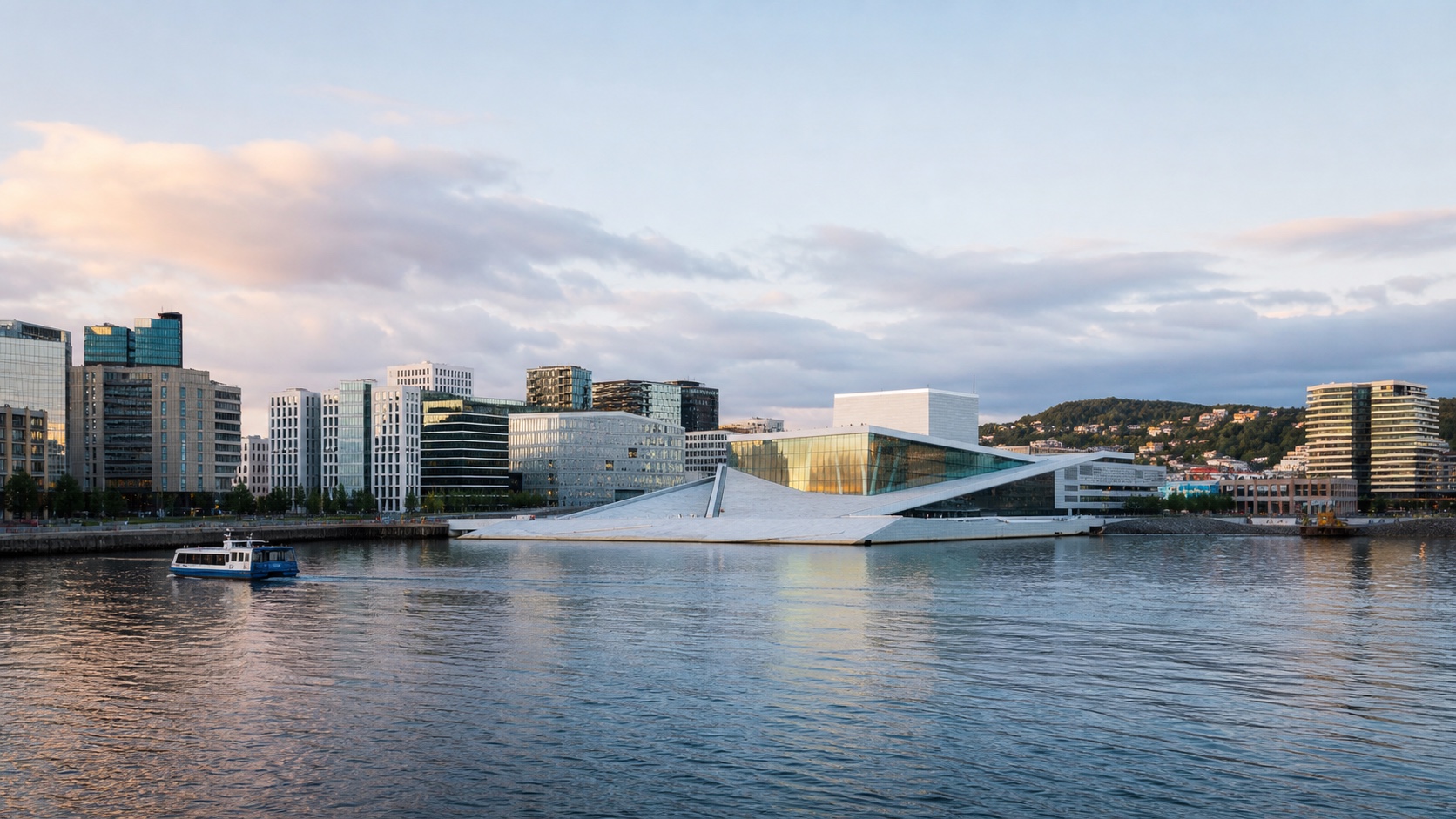
THE OVERVIEW
Begin beside Bjørvika for MUNCH, the Opera House and simple rail orientation, then widen the stay. The National Museum and Aker Brygge work together on the western waterfront, Frogner adds residential streets and the City Museum, and Grünerløkka or Tøyen changes the evening rhythm. The 22 July Centre deserves a careful standalone visit, while an electric fjord boat helps the harbour geography make sense. Three nights gives a strong city break; four protects more neighbourhood time and weather flexibility.
YEAR AT A GLANCE
The weather rhythm in Oslo.
Climate averages, not a forecast. Current conditions still need checking before travel.
- Jan-1.8° / -6.8°49 mm rain
- Feb-0.9° / -6.8°36 mm rain
- Mar3.5° / -3.3°47 mm rain
- Apr9.1° / 0.8°41 mm rain
- May15.8° / 6.5°53 mm rain
- Jun20.4° / 10.6°65 mm rain
- Jul21.5° / 12.2°81 mm rain
- Aug20.1° / 11.3°89 mm rain
- Sep15.1° / 7.5°90 mm rain
- Oct9.3° / 3.8°84 mm rain
- Nov3.2° / -1.5°73 mm rain
- Dec-0.5° / -5.6°55 mm rain
Average daily high, low and rainfall: World Meteorological Organization, data supplied by the Norwegian Meteorological Institute, Oslo, 1961 to 1990
area
Bjørvika and city centre
Waterfront culture and simple arrival
Use Bjørvika for the Opera House, MUNCH, rail connections and an efficient first orientation.
Details should be checked for your travel dates.area
Grünerløkka and Tøyen
Independent culture and neighbourhood evenings
These eastern districts add parks, local food and a less formal daily rhythm beyond the waterfront.
Details should be checked for your travel dates.area
Frogner
Museums, parks and residential streets
Frogner suits a quieter base with access to the City Museum, sculpture park and west-side neighbourhoods.
Details should be checked for your travel dates.area
Tjuvholmen and Aker Brygge
Waterfront art and open promenades
Use this polished waterfront for an easy art-and-harbour route rather than an entire day.
Details should be checked for your travel dates.experience
MUNCH
Waterfront art at architectural scale
Use the current exhibition programme to give the artist's work a focused visit beside Bjørvika.
Details should be checked for your travel dates.experience
National Museum
Choose a selective collection route
Build the visit around a small number of galleries rather than attempting the entire museum.
Details should be checked for your travel dates.experience
22 July Centre
A careful civic-history visit
Give the centre time and avoid placing another demanding visit immediately afterwards.
Details should be checked for your travel dates.experience
Oslo City Museum
Urban history at Frogner Manor
Use housing, work and city growth as context for the wider stay.
Details should be checked for your travel dates.experience
Electric fjord boat
Read the city from the water
A modern harbour sailing makes the fjord geography clear without turning the day into a long excursion.
Details should be checked for your travel dates.station
Oslo Airport Gardermoen
Main air gateway
Frequent rail and road connections link OSL with Oslo Central.
Details should be checked for your travel dates.station
Oslo Central Station
Main rail gateway
National, regional and airport trains arrive beside Bjørvika and the city centre.
Details should be checked for your travel dates.travel_advice
Oslo climate averages
Cold winters and mild summers
WMO normals for Oslo show 1961 to 1990 average daily highs from -1.8°C in January to 21.5°C in July. Mean monthly precipitation ranges from 36 mm in February to 90 mm in September and includes rain and snow.
Details should be checked for your travel dates.travel_advice
Choosing the time to go
Long summer days or a museum-led winter
May, June and September often balance daylight with comfortable museum and neighbourhood routes. July and August are busier, while winter suits a compact indoor programme with shorter outdoor sections.
Details should be checked for your travel dates.travel_advice
Plan winter and waterfront routes end to end
Ice, gradients and lift status matter
Rail, metro, trams, buses and boats connect the city well, but the complete route still includes platforms, quays, slopes and individual buildings. Confirm the arrival, hotel entrance, allocated room, bathroom, venue lift, seating, toilets and evening return.
Details should be checked for your travel dates.travel_advice
Current practical information
Recheck before travel
Check current entry guidance, transport work, ferry operations, event closures, museum access and the forecast for the actual stay. One timed cultural visit and one flexible district plan keep each day adaptable.
Details should be checked for your travel dates.STAY
Hotels to consider
A considered starting point, not a statement of availability or a booking recommendation.
Amerikalinjen
Central design-led base
Oslo, Norway
Consider this for rail convenience, strong design and a music-focused social programme.
Confirm the allocated room, bathroom, lift route and exact entrance directly.Camillas Hus
Small historic stay
Oslo, Norway
This suits a quieter residential base close to Palace Park and Frogner.
Confirm the room layout, bathroom, entrance and lift arrangements in this historic building.Sommerro
Large art deco base
Oslo, Norway
Choose this for substantial facilities and west-side access when a lively social setting fits.
Confirm the selected room, bathroom, lift route and whether busy social spaces suit the stay.ORIENTATION
A sense of place
Every marker uses coordinates supplied by the published Desk guide.
AT A GLANCE
Practical notes
- Typical stay
- 3 to 4 nights
- When to consider
- May, June and September often combine useful daylight with comfortable district and waterfront routes. July and August bring long days and stronger visitor demand. November to March are colder and darker, which can suit a museum-led stay when outdoor sections remain flexible. Check event dates, transport work and the current forecast.
- Climate
- WMO World Weather Information Service provides a complete 1961 to 1990 thirty-year climatology for Oslo using data supplied by the Norwegian Meteorological Institute. Average daily highs range from -1.8°C in January to 21.5°C in July, lows from -6.8°C in January and February to 12.2°C in July, and mean monthly precipitation from 36 mm in February to 90 mm in September. Precipitation includes rain and snow. These are climate averages, not a forecast.
- Languages
- Norwegian, English widely used in visitor services
- Currency
- NOK
- Getting around
- Oslo Airport connects with the centre by frequent rail and road services, while Oslo Central serves national, regional and airport trains. Metro, trams, buses and boats cover most city journeys. Check the full route across platforms, quays, hills and winter surfaces rather than relying on one accessible vehicle.
- Worth preparing for
- Oslo is well connected but not frictionless. Winter snow, ice and freeze-thaw cycles affect pavements, while hills, quays and lift outages can change an otherwise step-free journey. Confirm the airport or rail arrival, hotel entrance, allocated room, bathroom, venue lifts, seating, toilets, boat boarding and evening return.
Sources and credits
- Oslo official tourism · VisitOSLO
- Amerikalinjen official website · Amerikalinjen
- Camillas Hus official website · Camillas Hus
- Sommerro official website · Sommerro
- MUNCH official information · MUNCH
- National Museum official information · National Museum
- 22 July Centre official information · 22 July Centre
- Oslo City Museum official information · Oslo Museum
- Accessible attractions in Oslo · VisitOSLO
- Oslo Airport official information · Avinor
- Oslo Central Station official information · Bane NOR
- Norway travel advice · UK FCDO
- Oslo climatological information · WMO World Weather Information Service · Norwegian Meteorological Institute data; complete 1961 to 1990 monthly mean daily minimum and maximum temperatures and mean total precipitation
Guide last reviewed 28 September 2026.