
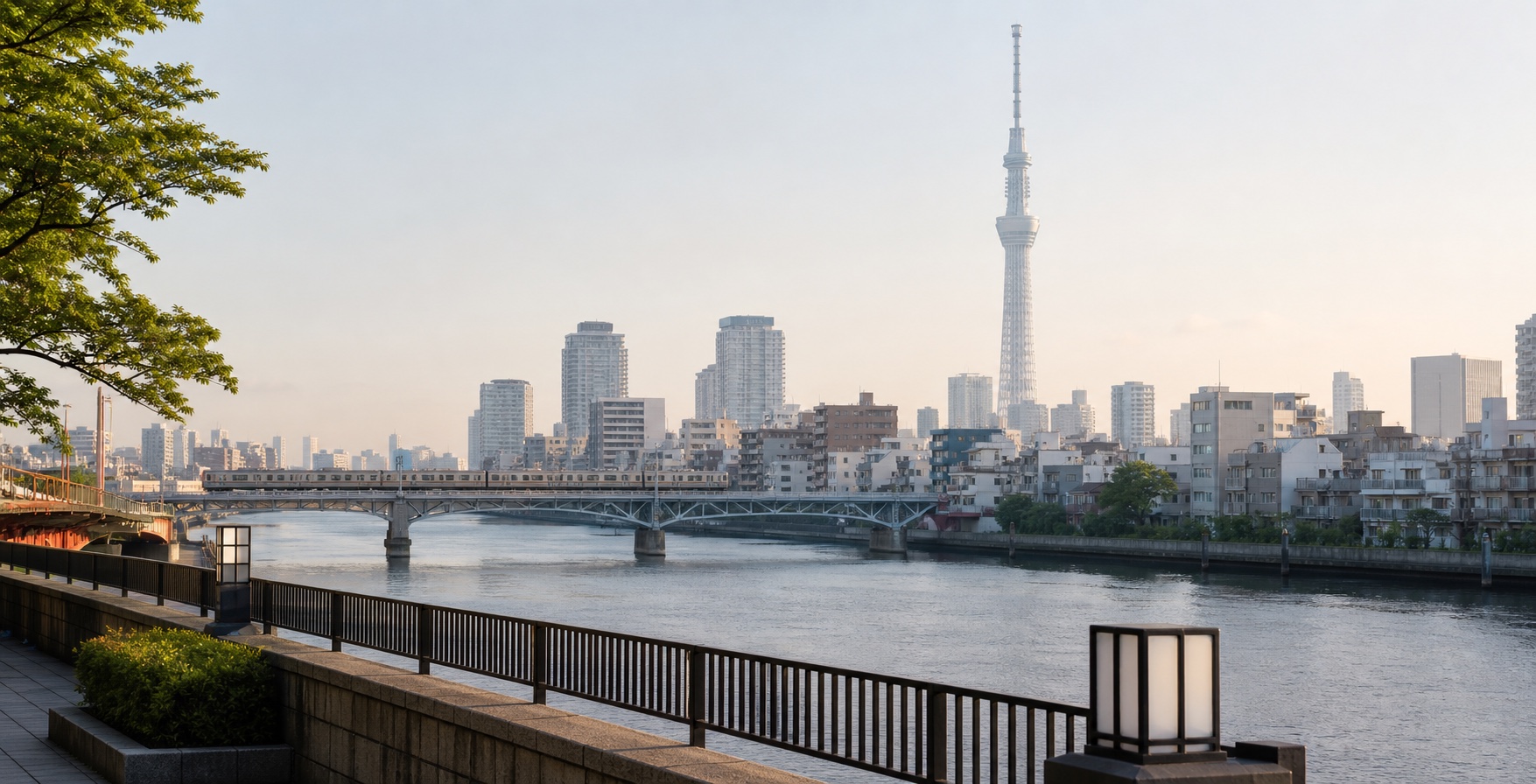
THE OVERVIEW
Five to seven nights gives Tokyo enough room for the west-side energy of Shibuya and Harajuku, the museums and older streets of Ueno and Yanaka, a focused central day and time to slow down. Choose the hotel around the neighbourhood rhythm, not simply a central point on the map.
YEAR AT A GLANCE
The weather rhythm in Tokyo.
Climate averages, not a forecast. Current conditions still need checking before travel.
- Jan9.8° / 1.2°59.7 mm rain
- Feb10.9° / 2.1°56.5 mm rain
- Mar14.2° / 5°116 mm rain
- Apr19.4° / 9.8°133.7 mm rain
- May23.6° / 14.6°139.7 mm rain
- Jun26.1° / 18.5°167.8 mm rain
- Jul29.9° / 22.4°156.2 mm rain
- Aug31.3° / 23.5°154.7 mm rain
- Sep27.5° / 20.3°224.9 mm rain
- Oct22° / 14.8°234.8 mm rain
- Nov16.7° / 8.8°96.3 mm rain
- Dec12° / 3.8°57.9 mm rain
Average daily high, low and rainfall: Japan Meteorological Agency climate normals, Tokyo, station 47662, 1991 to 2020
area
Marunouchi and Nihonbashi
Rail connections and a polished central base
A practical first base for Tokyo Station, eastern neighbourhoods and straightforward road transfers. The station scale still deserves planning.
Details should be checked for your travel dates.area
Ginza
Food, design and evening ease
Ginza keeps restaurants, galleries and shops close together, with good links east and west. Weekends can change street traffic patterns.
Details should be checked for your travel dates.area
Shibuya and Harajuku
Energy, fashion and late evenings
Choose this side of the city for an energetic stay, then keep each day within a small cluster rather than crossing Tokyo repeatedly.
Details should be checked for your travel dates.area
Asakusa, Ueno and Yanaka
Older streets, temples and museums
Eastern Tokyo works well for temple mornings, museum time and lower-rise neighbourhood walks, with enough contrast for several days.
Details should be checked for your travel dates.experience
Tokyo National Museum
Ueno · art and material culture
Choose one or two collections and leave time for the buildings and Ueno setting rather than trying to complete the whole museum.
Details should be checked for your travel dates.experience
Meiji Jingu
Harajuku · shrine and forest approach
Go early for a quieter walk through the forest approach, then continue into a nearby west-Tokyo neighbourhood.
Details should be checked for your travel dates.experience
Edo-Tokyo Museum
Ryogoku · city history
Use the museum to understand how governance, daily life, disaster and rebuilding have shaped the city.
Details should be checked for your travel dates.experience
Nezu Museum
Aoyama · art and garden
A focused collection and garden make a calm half-day close to Omotesando without repeating its commercial pace.
Details should be checked for your travel dates.experience
Yanaka neighbourhood walk
Northern Tokyo · small streets and temples
Keep this as an unhurried short route through local streets, temples and shops rather than a checklist.
Details should be checked for your travel dates.station
Haneda and Narita airports
Choose around the whole transfer
Haneda is closer to central Tokyo, while Narita is farther out. Select the airport and transfer around the hotel, luggage, mobility and arrival time.
Details should be checked for your travel dates.station
Tokyo Station and urban rail
Exact lines, gates and exits matter
Tokyo rail is exceptionally useful, but headline journey times do not include the distance through a station or between the exit and hotel.
Details should be checked for your travel dates.travel_advice
Heat, rain and seasonal planning
Climate averages, not a forecast
JMA normals show the warmest average daily highs in July and August, and the wettest monthly averages in September and October. June is also humid and wet. Check current forecasts and warnings before each day.
Details should be checked for your travel dates.travel_advice
Typhoon-aware planning
Check official warnings close to travel
JMA 1991 to 2020 statistics show Kanto and Koshin approaches are concentrated from July to October and highest on average in September. This describes past climate, not the likelihood of a storm on specific dates.
Details should be checked for your travel dates.travel_advice
Current travel advice
Check before booking and departure
Use current Japan travel advice for entry rules, natural hazards, local laws, insurance and health guidance. The guide does not replace official advice.
Details should be checked for your travel dates.travel_advice
Access and pacing
Plan the complete route
Short map distances can hide long station passages, crowd pressure, gradients or a final building entrance with steps. Plan by effort as well as distance.
Details should be checked for your travel dates.STAY
Hotels to consider
A considered starting point, not a statement of availability or a booking recommendation.
HOSHINOYA Tokyo
Otemachi · contemporary ryokan style
Tokyo, Japan
A calm central option for guests who want ryokan-style rituals without leaving the city centre.
Confirm the exact room, bedding, bathroom, lift route, footwear customs and vehicle arrival point.TRUNK(HOTEL) CAT STREET
Jingumae · sociable design stay
Tokyo, Japan
A west-side option for guests who want Shibuya and Harajuku close by and enjoy a lively public space.
Confirm the exact room, bathroom, lift route, street noise and transfer point.Hotel Niwa Tokyo
Kanda Misakicho · quieter practical base
Tokyo, Japan
A considered option for a more subdued immediate neighbourhood with useful rail links nearby.
Confirm room dimensions, bathroom, lifts and the walking route from the selected station.HIGHLIGHTS
Points of interest
Narita International Airport
The farther major airport has rail and bus links that need choosing around the hotel, luggage and arrival time.
Tokyo Haneda Airport
The closer major airport has rail, monorail, bus and road connections into the city.
Tokyo Station
A major Shinkansen and urban rail hub whose scale makes the exact line, gate and exit important.
Yanaka neighbourhood
Small temples, local shops and lower-rise streets create a gentler route through older Tokyo.
ORIENTATION
A sense of place
Every marker uses coordinates supplied by the published Desk guide.
AT A GLANCE
Practical notes
- Typical stay
- 5 to 7 nights
- When to consider
- March to May and October to November usually offer the most comfortable city days, though spring blossom periods and autumn weekends can be busy. June is humid and wet, July and August are hot, and typhoon disruption is most relevant from July to October. Winter is cooler and often drier, with New Year closures to check.
- Climate
- Japan Meteorological Agency 1991 to 2020 normals for Tokyo show average daily highs from 9.8°C in January to 31.3°C in August. Rainfall averages are highest in September and October and lowest in winter. These are climate averages, not a forecast.
- Languages
- Japanese and English
- Currency
- JPY
- Getting around
- Rail and metro cover most journeys, but stations can be vast and rush hour is demanding. Group each day by neighbourhood, identify the exact line, gate and accessible exit, and allow time for the final walk to the hotel or attraction.
- Worth preparing for
- Plan by station exit and walking effort, not map distance alone. Confirm the exact hotel room, bathroom, bedding, lifts and vehicle drop-off in writing. Check JMA warnings, transport disruption and official Japan travel advice before departure.
Sources and credits
- Official Tokyo destination information · Tokyo Convention and Visitors Bureau
- Tokyo accessibility information · Tokyo Convention and Visitors Bureau
- HOSHINOYA Tokyo · Hoshino Resorts
- TRUNK(HOTEL) CAT STREET · TRUNK(HOTEL) CAT STREET
- Hotel Niwa Tokyo · Hotel Niwa Tokyo
- Tokyo National Museum · Tokyo National Museum
- Meiji Jingu · Meiji Jingu
- Edo-Tokyo Museum · Edo-Tokyo Museum
- Nezu Museum · Nezu Museum
- Yanaka and Nezu visitor information · Tokyo Convention and Visitors Bureau
- Tokyo Haneda Airport · Tokyo International Air Terminal
- Narita International Airport · Narita International Airport
- Tokyo Station information · JR East
- Tokyo Metro visitor information · Tokyo Metro
- Japan travel advice · UK Foreign, Commonwealth and Development Office
- Tokyo climate normals · Japan Meteorological Agency · JMA climate normal, Tokyo station, 1991 to 2020
- Japan typhoon climatology · Japan Meteorological Agency · JMA 1991 to 2020 typhoon climatology
Guide last reviewed 13 September 2026.