THE OVERVIEW
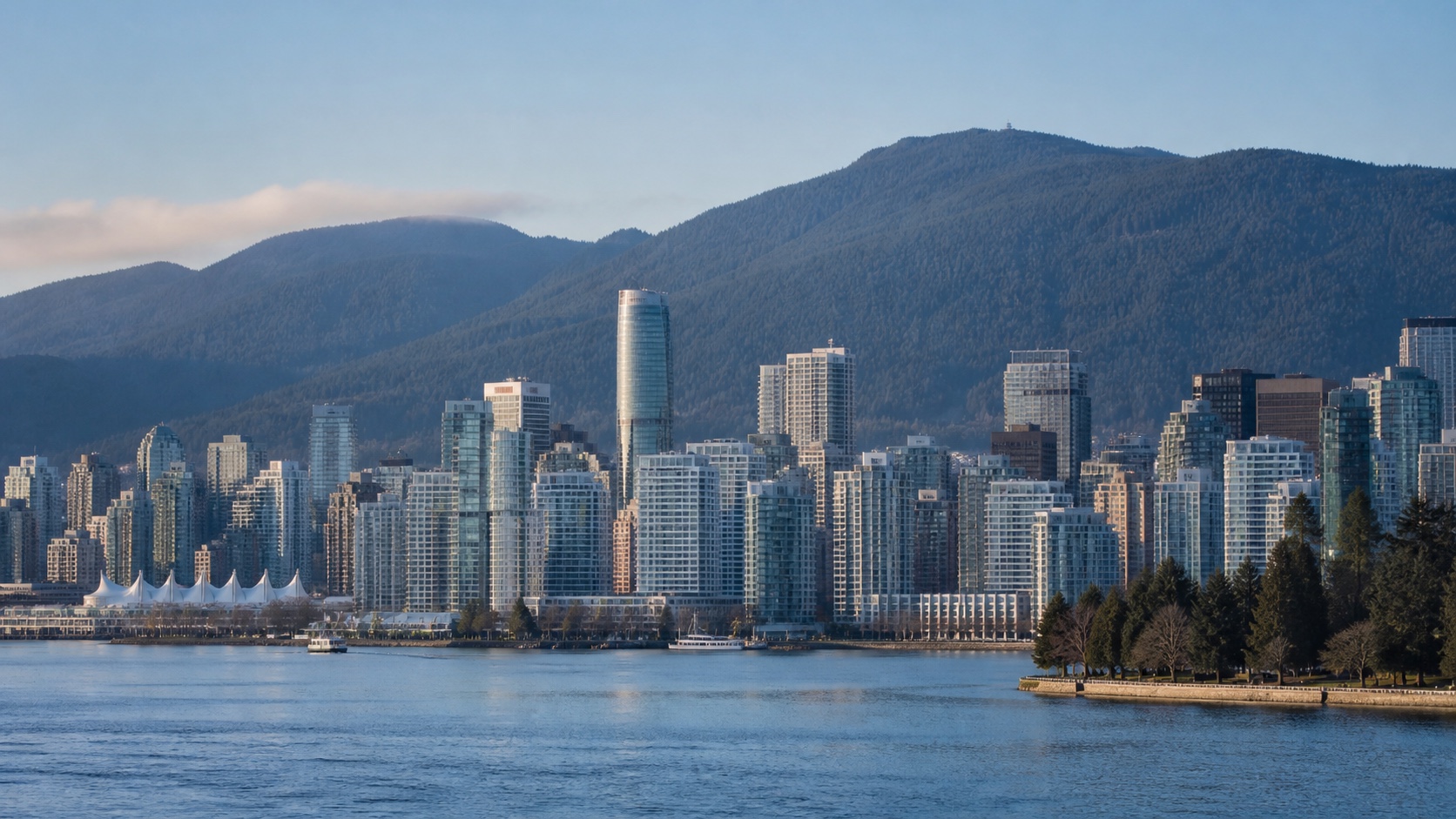
Begin with the downtown waterfront so the rail network, harbour and North Shore orientation become clear. Give Stanley Park one selected route, pair Science World with False Creek, and use the Vancouver Art Gallery or Museum of Vancouver as a focused indoor anchor. Granville Island is best approached as a deliberate loop rather than a rushed stop. Distances can look short on a map while gradients, waterfront detours, ferry boarding and changing weather make the practical journey longer. Keep every day geographically coherent and retain a weather-ready alternative.
YEAR AT A GLANCE
The weather rhythm in Vancouver.
Climate averages, not a forecast. Current conditions still need checking before travel.
- Jan7.4° / 3.3°236.6 mm rain
- Feb8.4° / 3.3°117 mm rain
- Mar10.5° / 4.6°162.5 mm rain
- Apr13.9° / 6.9°117.7 mm rain
- May17.8° / 10.2°72.6 mm rain
- Jun20.2° / 12.8°65.7 mm rain
- Jul23° / 14.9°43.5 mm rain
- Aug23° / 14.8°48.6 mm rain
- Sep19.4° / 12.1°71.4 mm rain
- Oct13.9° / 8.6°156.8 mm rain
- Nov9.7° / 5.3°245.2 mm rain
- Dec7.1° / 3.2°199.9 mm rain
Average daily high, low and rainfall: Environment and Climate Change Canada, Canadian Climate Normals, Vancouver Harbour composite station, 1991 to 2020
area
Downtown and Coal Harbour
Waterfront orientation and central access
Use Coal Harbour and the downtown grid to understand the relationship between the city, water and mountain horizon.
Details should be checked for your travel dates.area
Gastown and Railtown
Older streets and independent places
Build a short route around architecture, food and selected shops, then continue by a clear onward connection.
Details should be checked for your travel dates.area
West End
Park access and residential dining
The West End links a quieter grid of restaurants and streets with selected Stanley Park routes.
Details should be checked for your travel dates.area
Mount Pleasant
Independent businesses and local rhythm
Choose a compact stretch for food, design and a slower neighbourhood afternoon.
Details should be checked for your travel dates.experience
Vancouver Art Gallery
A selective exhibition route
Choose a few current exhibitions so the visit fits comfortably within a central city day.
Details should be checked for your travel dates.experience
Stanley Park
Seawall, forest and garden routes
Select one part of this large park rather than treating the entire perimeter as a single outing.
Details should be checked for your travel dates.experience
Science World
Hands-on exhibits beside False Creek
Pair a focused visit with a short waterfront route and a simple return from Main Street station.
Details should be checked for your travel dates.experience
Museum of Vancouver
City stories in Vanier Park
Use the current galleries as one focused stop within a waterfront half day.
Details should be checked for your travel dates.experience
Granville Island
Studios, food and working waterfront
Visit outside the busiest period and keep the market, studios and waterfront within one deliberate loop.
Details should be checked for your travel dates.station
Vancouver International Airport
Principal international gateway
Canada Line rail and road transfers connect YVR with different parts of the city.
Details should be checked for your travel dates.station
Waterfront Station
Central rail and ferry interchange
Use Waterfront for SkyTrain, SeaBus and commuter rail connections, with the correct entrance planned in advance.
Details should be checked for your travel dates.travel_advice
Vancouver climate averages
Mild temperatures and a pronounced wet season
Environment and Climate Change Canada normals for Vancouver Harbour show 1991 to 2020 average daily highs from 7.1°C in December to 23.0°C in July and August. Monthly precipitation ranges from 43.5 mm in July to 245.2 mm in November.
Details should be checked for your travel dates.travel_advice
Choosing the time to go
Drier summers and wet winters
Late spring to early autumn often supports longer waterfront and park days. Winter is mild by Canadian standards but much wetter in the city, with snow and rapidly changing conditions in the mountains.
Details should be checked for your travel dates.travel_advice
Plan the complete route
Surfaces, gradients and transfers matter
Confirm the airport transfer, hotel entrance, allocated room, bathroom, station lifts, ferry boarding, venue entrance, seating, toilets, walking surfaces, gradients and evening return.
Details should be checked for your travel dates.travel_advice
Current practical information
Keep guidance date-specific
Check wildfire smoke, flooding, severe weather, entry rules, healthcare, park guidance and current operating details for the actual journey.
Details should be checked for your travel dates.STAY
Hotels to consider
A considered starting point, not a statement of availability or a booking recommendation.
The Burrard
Informal downtown design base
Vancouver, Canada
Consider this for a compact central stay with mid-century character and a courtyard.
Confirm the selected room, bathroom, step-free route, exterior corridor, lift and complete transfer directly.DOUGLAS, Autograph Collection
Contemporary False Creek stay
Vancouver, Canada
Consider this for stadium events, False Creek and a large contemporary complex.
Confirm the selected room, bathroom, step-free route, lift, complex distances and complete transfer directly.Wedgewood Hotel & Spa
Traditional central city stay
Vancouver, Canada
Consider this for central galleries, Robson Square and a quieter service style.
Confirm the selected room, bathroom, step-free route, lift and complete transfer directly.ORIENTATION
A sense of place
Every marker uses coordinates supplied by the published Desk guide.
AT A GLANCE
Practical notes
- Typical stay
- 4 to 6 nights
- When to consider
- May to June and September often combine mild temperatures with workable waterfront days. July and August are driest and busiest. October to March is much wetter in the city, while mountain conditions can differ sharply. Check current rain, wildfire smoke, wind, snow, heavy-rain alerts, events and transport.
- Climate
- Environment and Climate Change Canada publishes a complete Vancouver Harbour 1991 to 2020 composite-station series. Average daily highs range from 7.1°C in December to 23.0°C in July and August, lows from 3.2°C in December to 14.9°C in July, and monthly precipitation from 43.5 mm in July to 245.2 mm in November. These are climate normals, not a forecast.
- Languages
- English and French, with additional language support at selected visitor sites
- Currency
- CAD
- Getting around
- Vancouver International Airport is the principal gateway, with Canada Line and road connections into the city. Waterfront Station links SkyTrain, SeaBus and commuter rail. Buses, rail, ferries and walking connect the central districts, but the correct station entrance, lift, ferry boarding point, gradient and complete hotel transfer need route-specific checks.
- Worth preparing for
- Vancouver is compact in outline but water, gradients, bridges and weather shape the real journey. Confirm the airport arrival, hotel entrance, allocated room, bathroom, station lifts, ferry boarding, venue entrances, seating, toilets, walking surfaces, gradients, weather exposure and evening return.
Sources and credits
- Vancouver official visitor information · Destination Vancouver
- Vancouver visitor accessibility information · Destination Vancouver
- The Burrard official website · The Burrard
- DOUGLAS, Autograph Collection official website · DOUGLAS, Autograph Collection
- Wedgewood Hotel & Spa official website · Wedgewood Hotel & Spa
- Vancouver Art Gallery visit information · Vancouver Art Gallery
- Stanley Park official information · City of Vancouver
- Science World visit information · Science World
- Museum of Vancouver visit information · Museum of Vancouver
- Granville Island official information · Granville Island
- Vancouver International Airport official information · Vancouver International Airport
- Waterfront Station transport information · TransLink
- Canada travel advice · UK FCDO
- Vancouver Harbour monthly climate normals · Environment and Climate Change Canada · Environment and Climate Change Canada Canadian Climate Normals; Vancouver Harbour composite station; complete 1991 to 2020 monthly mean daily maximum and minimum temperatures and total precipitation
Guide last reviewed 28 September 2026.